Barriers Non-Kin Adoptive Families Overcome When Adopting Through the U.S. Foster Care System

Why do so many families give up on adopting through foster care — and what can be done to change that?

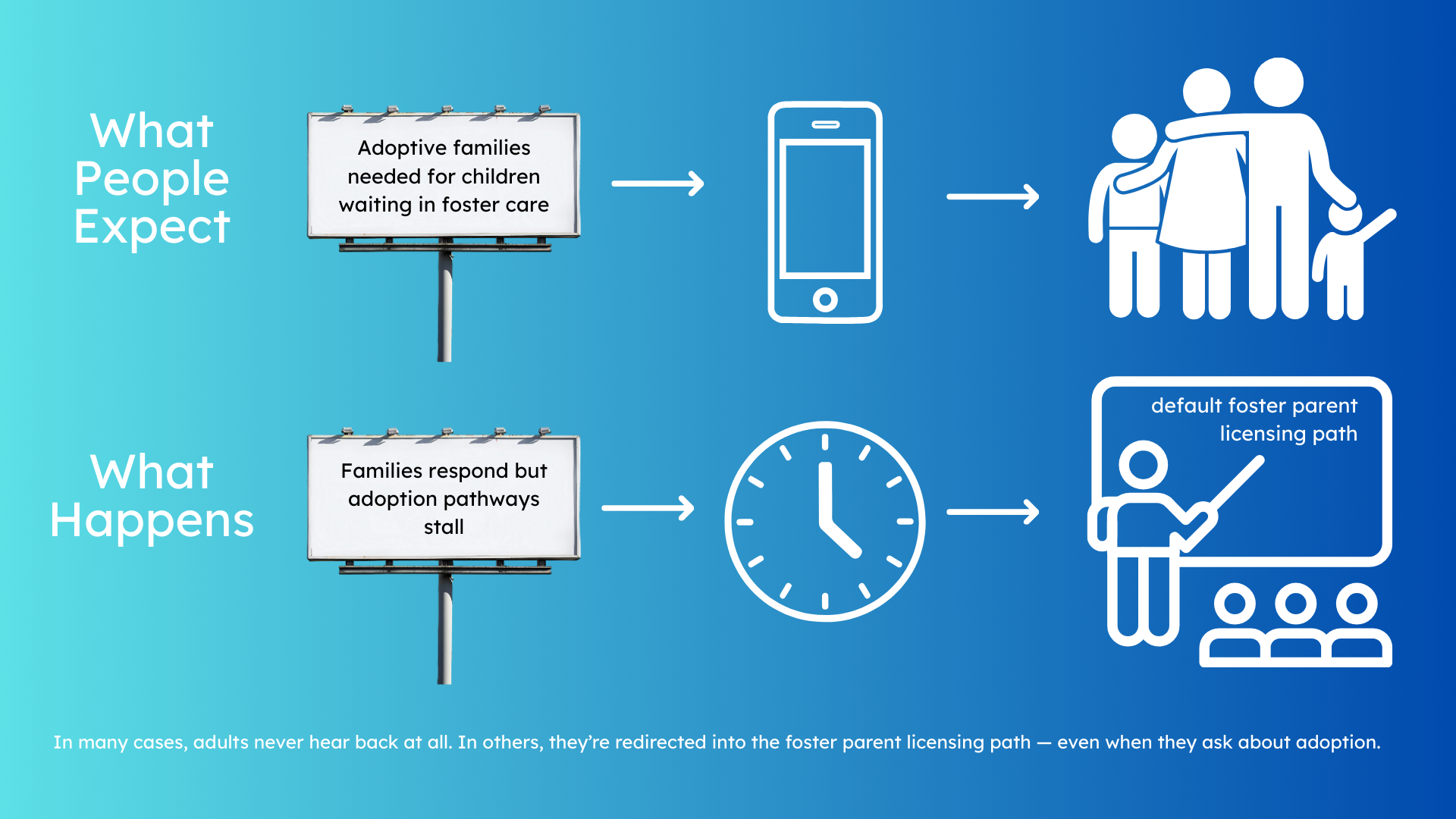
Grounded in real family stories and national data, this research reveals how inefficiency and inconsistency in the system create barriers for families — and shows what can make the path to adoption clearer, more consistent, and more supportive, so more children can grow up with the stability and lifelong support of a permanent family.

Download Policy Implications
Key Findings
Hear Their Stories
The Data

Bursac, M., Richards, K. V., Schroeder, C., & Hanlon, R. (2025). Barriers Non-Kin Adoptive Families Overcome When Adopting Through the U.S. Foster Care System. Families in Society. https://doi.org/10.1177/10443894251365713

This study represents 35 children who have been adopted through foster care. Today, more than 108,000 children — like some of those pictured above — are still waiting in the U.S. foster care system for a permanent family.

Each year, over 15,000 age out without the stability, love, and lifelong support they deserve. More than 15,000 children leave the system without the stability, love, and support of a permanent family.

Whether you’re a policymaker, practitioner, or prospective parent, this research invites you into a shared conversation—about what’s working, what’s not, and how we can do better together.

Photos used with permission from Heart Gallery of America. You can explore state-by-state photo listings of waiting children using the interactive map created through The Forgotten Adoption Option App.

The study was conducted by a collaborative team combining lived experience and academic expertise. Together, we examined families who successfully completed an adoption through the U.S. foster care system, using both data and family voices.

Research Team Behind the Study

My Story / Our Story

I didn’t begin this work as a researcher. It started with a mother’s heart. When I adopted siblings through the foster care system as my Plan A, I experienced both the beauty and the barriers up close.

Over the 18 months it took to finalize our adoption, my husband and I navigated an emotional and seemingly endless legal process. Through it all, one question kept echoing in my mind: Why isn’t this easier?

That question led to a partnership with three incredible researchers — Dr. Kristin Richards, Dr. Casey Schroeder, and Dr. Ryan Hanlon — who shared my belief that there were common themes that families like mine had to overcome to become a child, teen, or sibling group’s permanent, forever family.

With the support of trained volunteer interviewers, our team gathered in-depth narratives from families who successfully completed adoptions through the U.S. foster care system.

This is their story as much as it is mine.

And it’s our shared invitation to make adoption through foster care easier to understand and simpler to navigate, so families feel confident to take the next step, not just the first. When the process is clear and responsive, more families will stay engaged, say yes when the call comes, and show others that this is a system worth trusting.

KEY FINDINGS

Three Stages. Eight Barriers. Helping Children Find Families Faster.

Representing 35 adopted children through interviews with 20 families across six states, the research uncovered recurring themes that show where the system breaks down and how it could work better.

Licensing

Lost paperwork, inconsistent training, and frequent staff turnover delay the start of families’ journeys.

“We redid every form twice. Every time our caseworker changed, we started over.” — Non-kin adoptive parent, from the study

What Could Change
Streamlining documentation, improving staff continuity, and standardizing training across agencies could help families begin sooner and sustain momentum.

Placement

Families face rushed placement decisions with little preparation or alignment to their preferences.

“We wanted to be ready, but we didn’t even know what questions to ask.” — Non-kin adoptive parent, from the study

What Could Change
Matching families and children based on readiness and ongoing support rather than urgency can improve stability and outcomes.

Legal

Court delays and inconsistent practices extend timelines and leave children waiting.

“We redid every form twice. Every time our caseworker changed, we started over.” — Non-kin adoptive parent, from the study

What Could Change
Streamlining documentation, improving staff continuity, and standardizing training across agencies could help families begin sooner and sustain momentum.

1 in 4

children waiting

to be adopted in foster care

have no identified relative or foster caregiver planning to adopt them. These are the children most likely to need non-kin adoptive families ready to step forward.

The Numbers Behind the Stories

Every data point represents a child or sibling group still waiting for a permanent, loving family — and a system that can work better.

  • 108,000 children in the U.S. foster care system are waiting to be adopted.

  • 1 in 4 children waiting to be adopted in foster care have no identified relative or foster caregiver planning to adopt them, meaning they rely on non-kin adoptive families to find permanency.

  • Only 1 in 10 adoptions from foster care are finalized by non-kin families.

  • Families who pursue adoption through foster care often wait 335–430 days after parental rights are terminated before finalizing adoption.

  • 37% of families who consider adoption say the process itself discourages them from continuing.

In Their Own Words: Voices from Adoptive Parents

  • Our social workers would change every couple months . . . and then the next one wouldn’t know where the process was, and we’d have to learn a new worker.

  • It was very dragged out . . . you just have to be really, really patient . . . because you’re only one part of a very complex situation.

  • They would just call you and say, hey, there’s a kid—you’ve got just, like, a few minutes to decide yes or no.”

  • We had some issues with training courses. They kind of seemed like they were just kind of making it up as they went along.

  • We had at least five visits a month . . . it was just a little difficult to arrange when kids would be home and when we would be home from work.

  • I had a friend who was licensed through the agency . . . she made a call, and then people started talking to me.

  • CPS kind of doesn’t really go by their own procedure book . . . They use them when they need it and . . . when it’s convenient for them.

  • The person I was working with seemed to also have a lot going on in their personal life, which just seemed to be interfering with the process.

  • The hardest part to me was just . . . the constant moving the trial.

What’s Inside the Research

This study brings together data and real family experiences to give a full picture of adoption through the U.S. foster care system — what’s working, what’s not, and what can change.

Quantitative
Data

Adoption timelines and system patterns across six states.

Thematic
Analysis

Eight barriers across licensing, placement, and legal.

Family
Interviews

20 adoptive parents from 12 families who successfully navigated the process.

Policy
Insights

Opportunities to improve training and accountability.

Read the Published Study

Cite This Study

Copy and paste the citation below for your research or publications:

Bursac, M., Richards, K. V., Schroeder, C., & Hanlon, R. (2025). Barriers Non-Kin Adoptive Families Overcome When Adopting Through the U.S. Foster Care System. Families in Society. https://doi.org/10.1177/10443894251365713
  

Find Your Path

Change happens when everyone plays their part.

This research revealed barriers across every part of the adoption process, but also showed how families, advocates, and professionals can make the system better.

Choose the path that fits you best.

Stay Informed

Get updates and discover ways to get involved.

We’ll only send occasional updates about our research, impact, and opportunities to get involved. You can unsubscribe anytime.

About Marcy Bursac

marcy@forgottenadoptionoption.org

A Shared Vision for Change

What started as a blog to distract myself from the delays and emotions of the foster care adoption process became a space to teach others what it was really like to navigate foster care adoption as an adoptive parent. Over time, that choice of therapy grew into conversations in my living room, Zoom calls with families across the country, and now a national movement to make the process clearer, smoother, and easier to navigate.

Over the past decade, I’ve used what I learned—both from my own adoption experience and from listening to families nationwide—to help others find their way. From publishing books and developing reading programs to conducting national research and creating a free adoption app, every effort has been rooted in one belief: we really should have waiting parents, not waiting children.

But I can’t do this alone. I need your help.

Invite me to speak to your program or organization. Start conversations in your workplace or place of worship about adoption. Encourage a school to teach the Foster Care Adoption Awareness Reading Program. You can also support the mission by donating to The Forgotten Adoption Option or purchasing a JBloom Adoption Symbol Necklace. Every conversation, every partnership, and every act of generosity moves us closer to a system families can trust and children, teens, and sibling groups can count on.

Together, we can make adoption through foster care simpler, more supported, and within reach for the next family ready to begin — and help ensure no young person ages out of the system without a permanent family to rely on.